
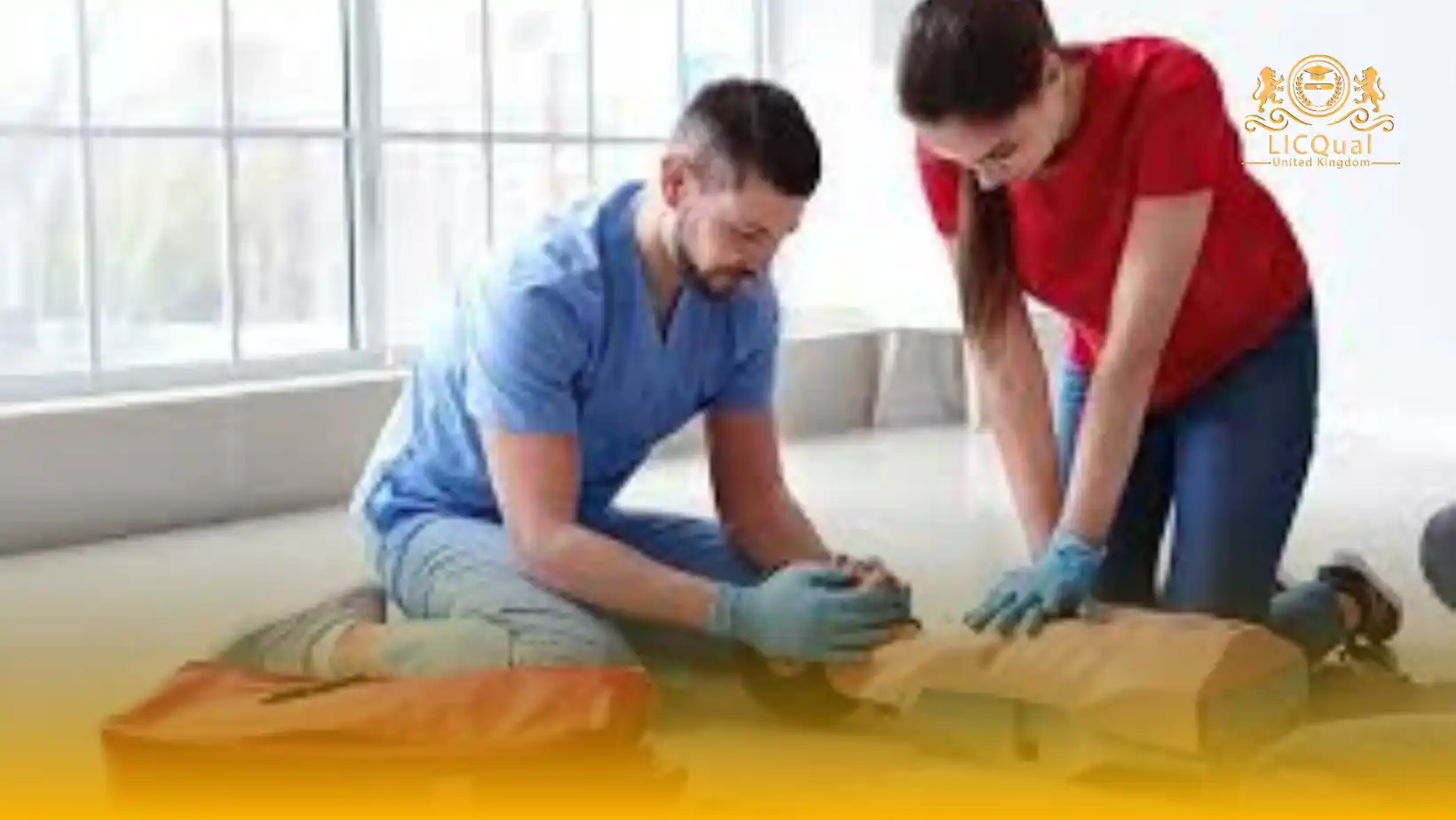
Award in First Aid
The LICQual Level 2 Award in First Aid is a comprehensive qualification designed to equip learners with advanced knowledge and practical skills to respond effectively in a wide range of medical emergencies. This course provides learners with the ability to assess incidents, manage complex injuries, and deliver immediate care with confidence and precision.
Learners develop expertise in life-saving techniques, including cardiopulmonary resuscitation (CPR), management of fractures and dislocations, choking response, severe bleeding control, and treatment of burns and respiratory emergencies. Emphasis is placed on both primary and secondary first aid, ensuring learners can handle critical situations in workplace or community settings.
Delivered through a combination of theoretical instruction and scenario-based practical exercises, learners gain hands-on experience in real-world emergency situations. On successful completion, learners receive the nationally recognized LICQual Level 2 Award in First Aid, validating their competence and enhancing their ability to protect lives and promote safety in any environment.
Course Overview
Qualification Title
LICQual Level 2 Award in First Aid
Total Units
6
Total Credits
6
GLH
12
Qualification #
LICQ2200045
Qualification Specification
To enroll in the LICQual Level 2 Award in First Aid, applicants must meet the following criteria:
|
Qualification# |
Unit Title |
Credits |
GLH |
|---|---|---|---|
|
LICQ2200045-1 |
Understanding the Role of the First Aider and Health & Safety |
1 |
2 |
|
LICQ2200045-2 |
Managing an Unresponsive Casualty |
1 |
2 |
|
LICQ2200045-3 |
Cardiac Arrest, CPR, and Use of an AED |
1 |
2 |
|
LICQ2200045-4 |
Managing Bleeding, Wounds, and Shock |
1 |
2 |
|
LICQ2200045-5 |
Treating Burns, Scalds, and Environmental Injuries |
1 |
2 |
|
LICQ2200045-6 |
Managing Fractures, Sprains, Strains, and Medical Emergencies |
1 |
2 |
By the end of this course, learners will be able to:
Unit 1: Understanding the Role of the First Aider and Health & Safety
- Understand the responsibilities and duties of a first aider in emergency situations.
- Demonstrate knowledge of health and safety principles, including risk assessment and safe practices.
- Explain the importance of maintaining confidentiality and professionalism when providing first aid.
- Recognize the need for personal protective equipment (PPE) and infection control during first aid interventions.
Unit 2: Managing an Unresponsive Casualty
- Identify signs of unresponsiveness and perform a thorough primary survey of a casualty.
- Demonstrate the correct procedure for placing an unresponsive casualty in the recovery position.
- Perform airway, breathing, and circulation (ABC) checks and assess the need for further medical assistance.
- Understand how to act quickly and effectively to stabilize an unresponsive casualty until professional help arrives.
Unit 3: Cardiac Arrest, CPR, and Use of an AED
- Recognize the signs and symptoms of cardiac arrest and understand when CPR is required.
- Perform effective chest compressions and rescue breaths during CPR on an adult casualty.
- Understand how to use an Automated External Defibrillator (AED) to deliver a shock and restore heart function.
- Understand the importance of early defibrillation and high-quality CPR in increasing survival rates.
Unit 4: Managing Bleeding, Wounds, and Shock
- Identify different types of bleeding (e.g., arterial, venous, and capillary) and apply appropriate control measures.
- Use dressings, bandages, and pressure techniques to manage and control severe bleeding.
- Recognize the signs of shock and provide effective first aid interventions to stabilize the casualty.
- Understand the importance of preventing infection in wounds and applying appropriate wound care.
Unit 5: Treating Burns, Scalds, and Environmental Injuries
- Recognize and assess the severity of different types of burns and scalds, and provide appropriate first aid treatment.
- Demonstrate the correct procedure for cooling and dressing burns and scalds to minimize damage.
- Manage environmental injuries, including heatstroke, hypothermia, frostbite, and dehydration.
- Recognize signs of poisoning and provide immediate care until professional medical help arrives.
Unit 6: Managing Fractures, Sprains, Strains, and Medical Emergencies
- Identify and assess different types of fractures, sprains, and strains, and understand their severity.
- Apply effective first aid techniques to immobilize fractures and support injured limbs using splints or bandages.
- Use the R.I.C.E. method (Rest, Ice, Compression, Elevation) to treat sprains and strains.
- Recognize and provide first aid for various medical emergencies, such as seizures, strokes, and asthma attacks.
This diploma is ideal for:
Assessment and Verification
All units within this qualification are subject to internal assessment by the approved centre and external verification by LICQual. The qualification follows a criterion-referenced assessment approach, ensuring that learners meet all specified learning outcomes.
To achieve a ‘Pass’ in any unit, learners must provide valid, sufficient, and authentic evidence demonstrating their attainment of all learning outcomes and compliance with the prescribed assessment criteria. The Assessor is responsible for evaluating the evidence and determining whether the learner has successfully met the required standards.
Assessors must maintain a clear and comprehensive audit trail, documenting the basis for their assessment decisions to ensure transparency, consistency, and compliance with quality assurance requirements.